What are important changes regarding the relationship between employer and employee?
The Covid-19 pandemic greatly tested and changed the limits of the employer-employee relationship beyond anyone’s anticipation. The pandemic showed us the great resilience and adaptability of employees and employers in insecure times. From one day to the next, employees exchanged their office desks for their kitchen tables and their in-person meetings for Microsoft Teams meetings (Maryland The Daily Record). However, not every aspect of the pandemic had a positive effect on the employer-employee relationship. Some sectors were more affected by the pandemic than others and so were these sectors’ employees. Young employees, minorities, and women were for example more prone to economic and health risks in the workplace than other employees in different sectors. These factors all had an effect on the employer-employee relationship (The Wall Street Journal).
The employer-employee relationship was influenced by an array of elements. Economic growth, the use of technology, unexpected disasters, climate change, social divides in education, wealth, and health (Korn Ferry). However, Deloitte’s 2021 study regarding the worker-employee relationship found that the most influential factors for the development of the employer-employee relationship are talent supply and government impact (Deloitte).
Seven in ten employers globally are struggling to find workers with the right mix of skills to fill their vacancies. This availability of talent will influence both how workers seek employment and how organizations access and retain these employees. The availability and supply of talent could influence how organizations will invest in accessing these talents or lean on technology to fill the shortage in skilled staff (Deloitte).
Government actions on climate change, social justice, jobs and wages, enhanced social benefits, access to education, and investments in reskilling could influence the employer-employee relationship in multiple ways. Public policies might affect organizations for example in their quest to access cross-border talents. These policies could influence workforce planning and talent strategies (Deloitte).
The report by Deloitte found four possible answers.
Work as fashion. In this scenario, employers are chasing worker sentiments, similar to how fashion brands chase consumer sentiment. The employer-employee relationship is reactive in this scenario, employers react to the preferences of workers and the moves of their competitors. This reality could arise with low talent supply and low government impact. Low talent supply creates a labor market in which talented employees have the upper hand. They can base their choices on their immediate desires. And if governments do not offer support to employees, employees will demand employers to provide what they are not getting from their governments. After all, these talented employees are highly desired by employers (Deloitte).
War between talent. In this scenario, talented workers compete for limited jobs due to the overkill of talent. Employees are therefore seen as easily interchangeable and replaceable, and employees do not pick and choose between employees due to the scarcity of the jobs they are qualified for. The employer-employee relationship is impersonal. This will happen when there is a high supply of talent and low government impact (Deloitte).
Work is work. In this scenario, employees and employers view organizational responsibility and personal and social fulfillment as separate domains. The employer-employee relationship is professional. The expectations of employees and employers overlap, and finding purpose and meaning should be sought outside of the professional environment. Low talent supply and high government impact will lead to this future (Deloitte).
Purpose unleashed. In this scenario, the purpose is the dominant force driving the relationship between workers and employers. The employee and the employer see shared purpose as the relationship of their relationship. High government impact and high talent supply will lead to this scenario becoming reality. Their relationship is communal (Deloitte).
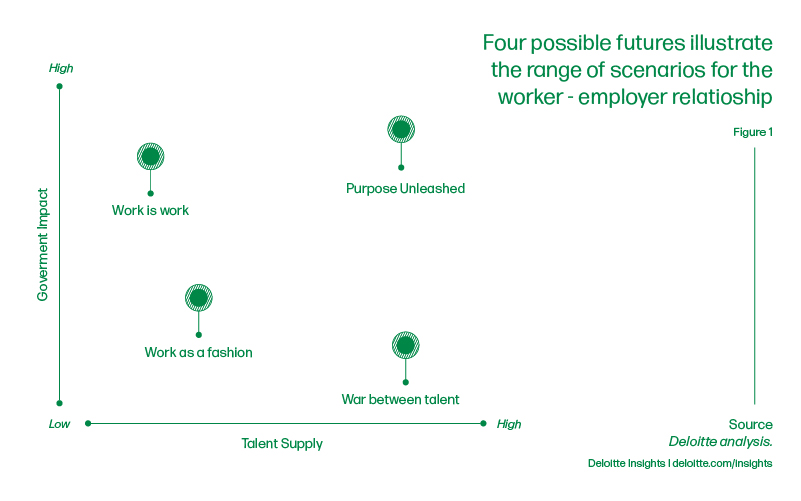
These four scenarios are illustrative, not exhaustive. Each scenario has opportunities and risks. Most organizations will most likely find themselves in a combination of these scenarios. However, the purpose unleashed scenario was expected by the Deloitte report to be already happening this time last year. The work as fashion scenario is expected to unleash this year in 2022 (Deloitte).
The employee-employer relationship does not have one single future. There is a multitude of possibilities, but without a clear chosen path or course, organizations face the risk of bad performance. In the end, a good employee-employer relationship will create a pleasant work environment for the employee. Subsequently, an employee does their job better. This eventually will lead to a better-performing organization (Deloitte).
J. Arbutus, ‘Pandemic has brought a change in the employee-employer relationship’, published by Maryland The Daily Record, https://thedailyrecord.com/2021/10/20/pandemic-has-brought-a-change-in-the-employee-employer-relationship/
J. Schartz et al., ‘The worker-employer relationship disrupted’, published by Deloitte, https://www2.deloitte.com/us/en/insights/focus/human-capital-trends/2021/the-evolving-employer-employee-relationship.html
K. Eaton, Rethinking the employer-employee relationship, published by The Wall Street Journal, https://deloitte.wsj.com/articles/rethinking-the-employer-employee-relationship-01628713534
Korn Ferry, ‘Future of work trends’, published by Korn Ferry, https://www.kornferry.com/content/dam/kornferry-v2/featured-topics/pdf/FOW_TrendsReport_2022.pdf