In today's fast-paced digital landscape, businesses are facing unprecedented challenges in meeting the evolving needs of their customers. COVID-19 accelerated the shift towards digital, with even non-digital companies now forced to adapt to the new reality. In such a market context, Quantum Metric has emerged as a leading player, helping companies navigate the complexities of digital transformation and improve their customer experience. The rise of e-commerce, the increasing importance of customer experience, and the growing demand for personalized services have turned this into a table stakes capability.
Quantum Metric's platform provides a comprehensive solution for enabling businesses to analyze and optimize their digital experiences across all channels. At the heart of Quantum Metric's solution is BigQuery, Google’s fully managed, petabyte-scale analytics data warehouse with 99.99% availability that enables businesses to analyze vast amounts of data in real-time to make data-driven decisions and have actionable insights to drive better outcomes.
Use cases: Challenges and problems resolved
Use case 1: Retargeting
Sometimes someone lands on your website or mobile app but fails to accomplish what you want them to do, such as adding an item to their shopping cart or creating a new checking account. Frustrated customers don’t convert, open an account, or buy an airline ticket. They just leave.
Oftentimes, we don’t know why the error happened or what we can do to fix it. Wouldn’t it be great to reach out to a potential customer with a nice message to say, “Sorry, but we understand what happened and we want to make it right.”? How might customers feel if they received an email or chat prompt shortly after encountering a problem, so that they could speak with a representative?
Together, Quantum Metric and BigQuery address this problem. With the Quantum Metric and BigQuery integration, you can investigate user behavior, including what exactly happens when a cohort of users (e.g. Android users) don’t convert.
For example, behavioral signals have helped a Retailer personalize retargeting messages for customers who struggled online or saw “out of stock” messages. The retailer’s Marketing Analytics team claimed they were getting more out of retargeting spend with deeper insights into what happened during a customer’s session.
Use case 2: Informing a customer data platform (CDP)
Customer data platforms (CDPs) can enable real-time decision making, which is one of the major benefits of big data analytics. Experience data adds a layer of activation, especially if it’s delivered in real time.
Imagine you are an airline company optimizing the digital transformation journey. Most airlines offer loyalty status or programs, and this program is usually built in tandem with a CDP. This allows airlines to get a 360-degree view of the customer from multiple sources of data across different systems. When you combine customer data with experience data, you can better understand how important segments of your audience are navigating through your website and mobile app.
For example, you can see when loyalty members are showing traits of frustration and deploy a rescue via chat, or even trigger a call from a special support agent. You can also send follow-up offers like promos to drive frustrated customers back to your website. The combined context of behavior data and customer loyalty status data allows you to be more pragmatic and effective with your resources. This means taking actions to maintain and strengthen your customer’s loyalty and drive conversion.
Use case 3: Personalization
The above CDP example is just the beginning of what you can achieve with the Quantum Metric and BigQuery integration. With a joined dataset, informed by real-time behavioral data, you can start to develop truly impactful personalization programs.
Imagine you are a large retailer that sells mostly commodities and need to perform well on Black Friday. With Quantum Metric and BigQuery, your business has real-time data on product engagement, such as clicks, taps, view time, frustration, and other statistics. When your business combines these insights with products available by region and competitive pricing data, you have a recipe for success when it comes to generating sales on Black Friday.
With these data insights, retailers can create cohorts of users (age, device, loyalty status, purchase history, etc.) and these cohorts receive personalized product recommendations based on business, technical and behavior data. These recommendations will tend to perform better with consumers, since the product recommendations are in-stock and tailored to the customers’ needs.
Solution: Why Quantum Metric built on Google Cloud
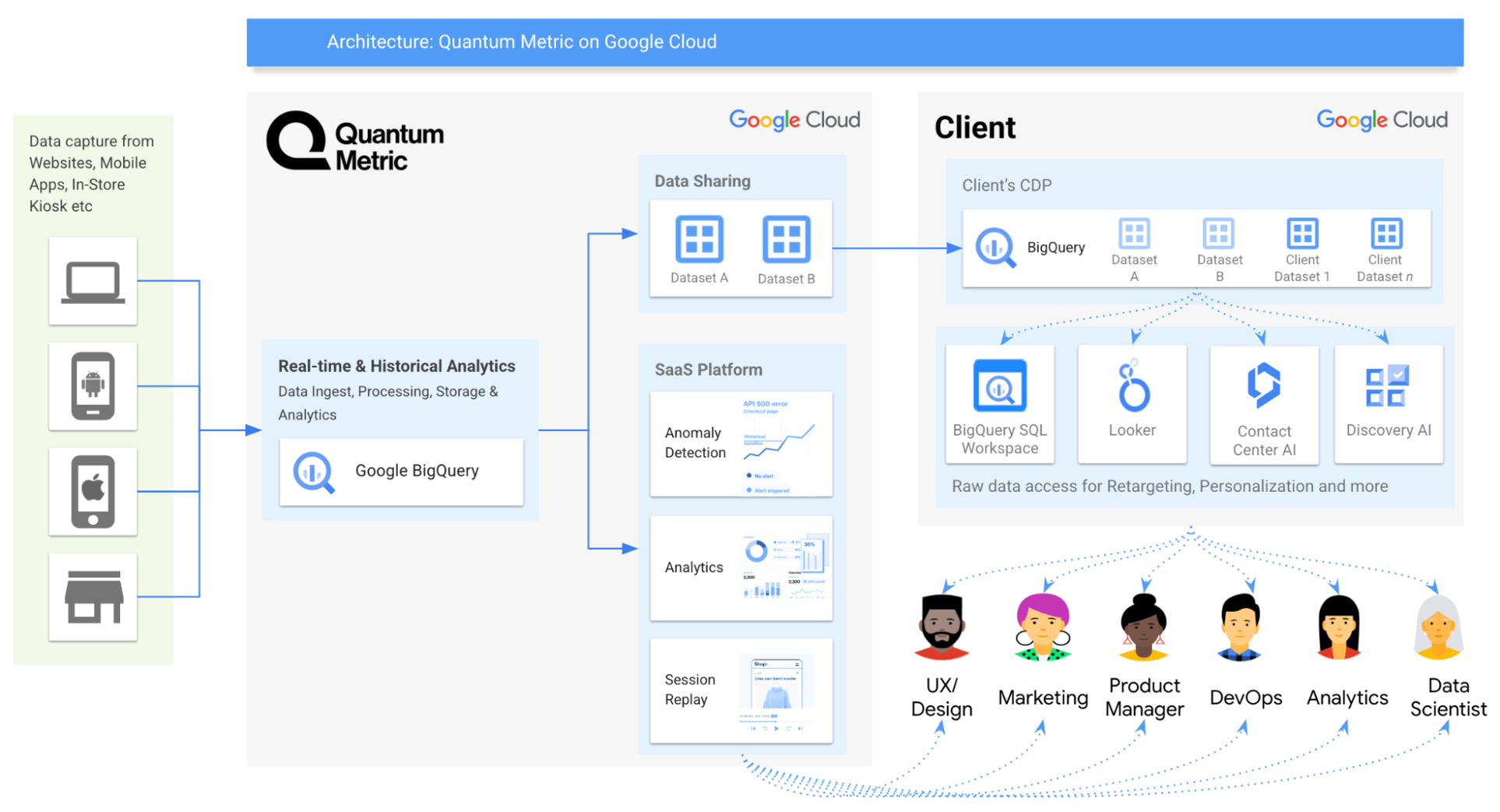
Below is an architecture diagram of how Quantum Metric operates on Google Cloud.
Data from various sources such as websites, mobile devices, kiosks are ingested into BigQuery using Google Cloud services. This data is in turn processed and analyzed for both real-time and historical analytics and stored in BigQuery datasets. Quantum Metric Platform provides out of the box dashboards to cater to multiple audiences ranging from Marketing, Product Managers to Analysts. In addition, the raw datasets can be shared securely with the client so they can query in their BigQuery instance or even coalesce with other datasets to develop more insights using Looker.
Optimizing the retail experience with advanced analytics
The Built with BigQuery advantage for ISVs and Data Providers