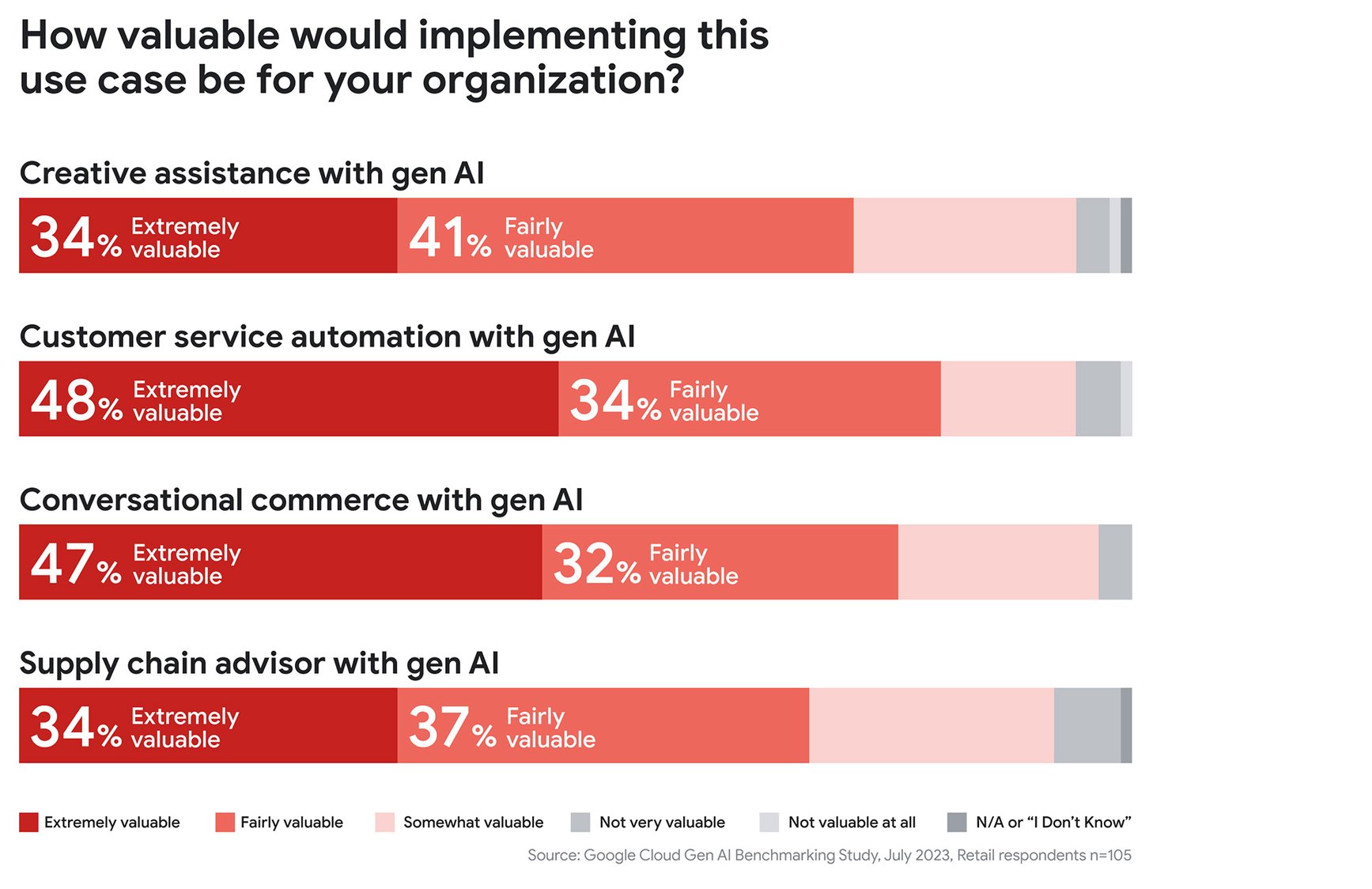
1. Creative assistanceWith 73% of retail customers expecting brands to just
know their preferences, generative AI is helping retailers deliver highly engaging, personalized, and creative content in more cost-effective and timely ways.
Using generative AI to quickly
prototype and create content not only saves time and lowers costs, but it also unlocks new levels of creativity and innovation. With Google Cloud, you can harness generative AI to create highly personalized and relevant content for specific audiences, helping drive better engagement and conversion. You can also test and refine new ideas rapidly, focus on strategy development, and improve customer engagement.
2. Conversational commerceTo drive more sales, retail organizations are turning to generative AI for conversational commerce — building virtual stylists that help consumers find what they need (e.g., “Here are some dresses in your size and style you may like, and images of influencers for style inspiration”). By interactively addressing queries, providing personalized product recommendations, and engaging with customers in real time, these stylists can also influence shopping decisions.
It’s a great way to solve issues like search abandonment. Retailers globally report combined losses of
over $2 trillion each year due to this problem, with only 1 in 10 consumers saying they find exactly what they’re looking for when they use a retail website’s search function.
Watch this demo to see how retailers are using generative AI to design personal stylists that can interact with shoppers and provide personalized solutions.
3. Product catalog managementGenerative AI transforms how retailers build and maintain product catalogs. You can build studio-grade imagery from simple text prompts, accelerate categorization, and generate great customer-centric marketing copy.
It’s an ideal solve for some of the common problems relating to catalog management — such as getting images from vendors, sorting and categorizing products, and writing product copy. All these things previously took up a lot of time and effort, and compromised the searchability of retail websites. With 92% of consumers more likely to buy a product when they
can easily find it, ensuring your products are easily searchable through up-to-date catalogs is key.Watch this demo to see how retailers are using generative AI to accelerate product catalog management and improve customers’ shopping and search experiences.
4. New product developmentProduct development and innovation can be faster and more cost-effective with generative AI. You can use it to accelerate research to find insights across multiple data sources, reduce product R&D costs, and zero in on successful product concepts faster. You can enhance internal consumer research with easy querying, summarization, and insight generation. Plus, you can quickly and easily create copy concepts and claims for further testing, and visual concepts for product and packaging designs.
Watch this demo to see how retailers are accelerating product innovation through data-led insights with the help of generative AI.
5. Customer service automationAn invaluable addition to your customer service strategy, generative AI not only supports your customer service reps in real time with helpful answers to customer enquiries, but it can help you scale and optimize other areas of your operations, too. For example, virtual agents can take the load off your contact center. Or, you could use it to summarize conversations and customer service data, and then generate new FAQ content to publish on your website.
With an estimated
75% of customers using multiple channels in their ongoing experience, generative AI helps you extend great customer service across all touchpoints — from digital self-service channels to agent-supported options in branches, call centers, and social media platforms.
Generative AI can enable instant, humanized customer service to help your customers easily and quickly find the answers they need.