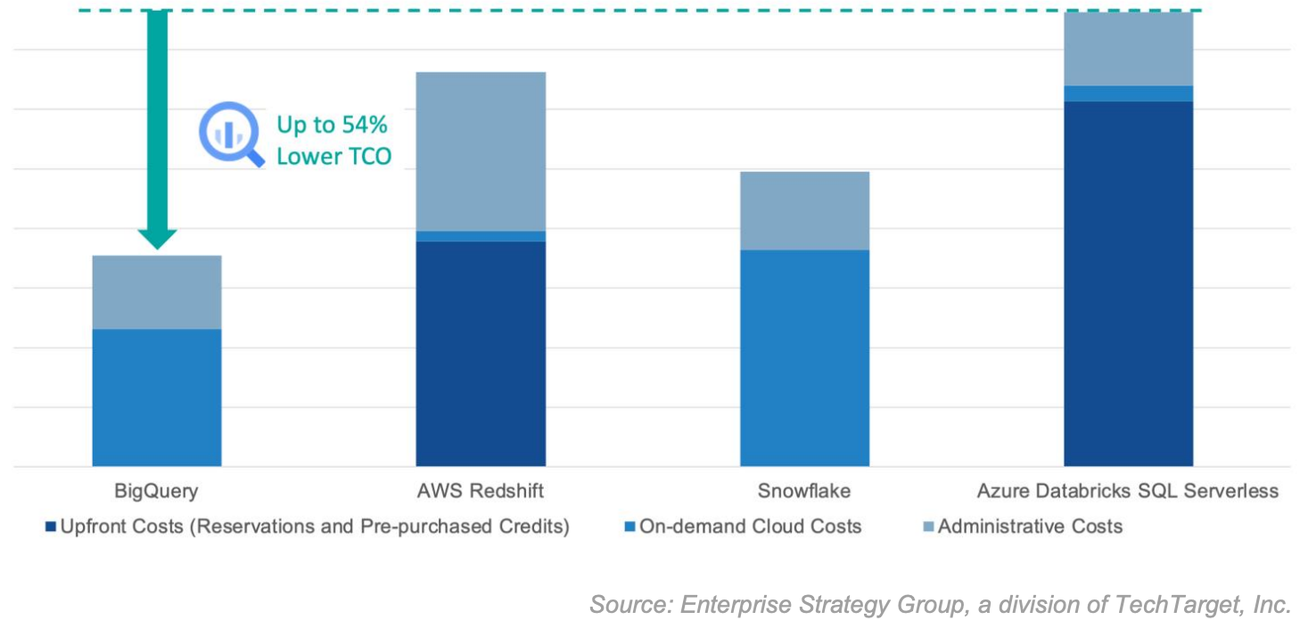
Transitioning to the cloud already helps to save on costs by eliminating management and maintenance of on-premise hardware. By selecting an EDW that’s fully managed and doesn’t require dedicated capacity monitoring, teams can easily manage data processing without additional engineering resources, and can focus on higher-value work than managing physical or virtual nodes.
As company datasets grow, so do costs. Teams require additional storage space and processing capabilities to keep pace, but not all of their backlog of data is necessary; sometimes that data is simply forgotten. An EDW that can automatically optimize for unused data can reduce costs by 50%.
The right cloud strategy can also help valuable data work harder. Data products that integrate directly with your EDW, such as
BigLake and
BigQuery Omni in the Google Cloud data product suite, reduce the cost and complexity of end-to-end data management because the products are already designed to connect to one another. Additional tools such as
Google Cloud Deployment Manager also help automate important security tasks by creating IAM custom roles to ensure data is only shared with the right people.
Effective data configuration, management, and monitoring is just the beginning of maintaining a data warehouse. Daily EDW administrative work also includes everything from supporting extract, transform, and load (ETL) workloads to troubleshooting, managing security, and collaborating with analysts. Leading data teams are looking for ways to simplify or eliminate some of these tasks to allocate resources toward growing their business.